
Download Literary Impostors: Canadian Autofiction of the Early Twentieth Century PDF Free - Full Version
Download Literary Impostors: Canadian Autofiction of the Early Twentieth Century by Rosmarin Heidenreich in PDF format completely FREE. No registration required, no payment needed. Get instant access to this valuable resource on PDFdrive.to!
About Literary Impostors: Canadian Autofiction of the Early Twentieth Century
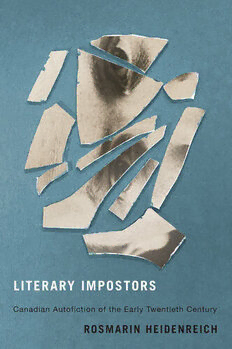
In the first half of the twentieth century, a number of Canadian authors were revealed to have faked the identities that made them famous. What is extraordinary about these writers is that they actually "became," in everyday life, characters they had themselves invented. Many of their works were simultaneously fictional and autobiographical, reflecting the duality of their identities. In Literary Impostors, Rosmarin Heidenreich tells the intriguing stories, both the "true" and the fabricated versions, of six Canadian authors who obliterated their pasts and re-invented themselves: Grey Owl was in fact an Englishman named Archie Belaney; Will James, the cowboy writer from the American West, was the Quebec-born francophone Ernest Dufault; the prairie novelist Frederick Philip Grove turned out to be the German writer and translator Felix Paul Greve. Chief Buffalo Child Long Lance, Onoto Watanna, and Sui Sin Far were the chosen identities of three mixed-race writers whose given names were, respectively, Sylvester Long, Winnifred Eaton, and Edith Eaton. Heidenreich argues that their imposture, in some cases not discovered until long after their deaths, was not fraudulent in the usual sense: these writers forged new identities to become who they felt they really were. In an age of proliferating cyber-identities and controversial claims to ancestry, Literary Impostors raises timely questions involving race, migrancy, and gender to illustrate the porousness of the line that is often drawn between an author's biography and the fiction he or she produces.
Detailed Information
| Author: | Rosmarin Heidenreich |
|---|---|
| Publication Year: | 2018 |
| ISBN: | 9780773555280 |
| Language: | English |
| File Size: | 7.875 |
| Format: | |
| Price: | FREE |
Safe & Secure Download - No registration required
Why Choose PDFdrive for Your Free Literary Impostors: Canadian Autofiction of the Early Twentieth Century Download?
- 100% Free: No hidden fees or subscriptions required for one book every day.
- No Registration: Immediate access is available without creating accounts for one book every day.
- Safe and Secure: Clean downloads without malware or viruses
- Multiple Formats: PDF, MOBI, Mpub,... optimized for all devices
- Educational Resource: Supporting knowledge sharing and learning
Frequently Asked Questions
Is it really free to download Literary Impostors: Canadian Autofiction of the Early Twentieth Century PDF?
Yes, on https://PDFdrive.to you can download Literary Impostors: Canadian Autofiction of the Early Twentieth Century by Rosmarin Heidenreich completely free. We don't require any payment, subscription, or registration to access this PDF file. For 3 books every day.
How can I read Literary Impostors: Canadian Autofiction of the Early Twentieth Century on my mobile device?
After downloading Literary Impostors: Canadian Autofiction of the Early Twentieth Century PDF, you can open it with any PDF reader app on your phone or tablet. We recommend using Adobe Acrobat Reader, Apple Books, or Google Play Books for the best reading experience.
Is this the full version of Literary Impostors: Canadian Autofiction of the Early Twentieth Century?
Yes, this is the complete PDF version of Literary Impostors: Canadian Autofiction of the Early Twentieth Century by Rosmarin Heidenreich. You will be able to read the entire content as in the printed version without missing any pages.
Is it legal to download Literary Impostors: Canadian Autofiction of the Early Twentieth Century PDF for free?
https://PDFdrive.to provides links to free educational resources available online. We do not store any files on our servers. Please be aware of copyright laws in your country before downloading.
The materials shared are intended for research, educational, and personal use in accordance with fair use principles.

