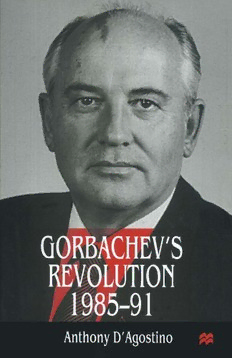
Table Of ContentGORBACHEV'S REVOLUTION, 1985-1991
Also by Anthony D' Agostino
MARXISM AND TIlE RUSSIAN ANARCHISTS
SOVIET SUCCESSION STRUGGLES
Gorbachev's Revolution,
1985-1991
Anthony D' Agostino
© Anthony D' Agostino 1998
Softcover reprint of the hardcover 1s t edition 1998
All rights reselVed. No reproduction, copy or transmission of
this publication may be made without written permission.
No paragraph of this publication may be reproduced, copied or
transmitted save with written permission or in accordance with
the provisions of the Copyright, Designs and Patents Act 1988,
or under the terms of any licence permitting limited copying
issued by the Copyright Licensing Agency, 90 Tottenham Court
Road, London W1P 9HE.
Any person who does any unauthorised act in relation to this
publication may be liable to criminal prosecution and civil
claims for damages.
The author has asserted his right to be identified
as the author of this work in accordance with the
Copyright, Designs and Patents Act 1988.
First published 1998 by
MACMILLAN PRESS LTD
Houndmills, Basingstoke, Hampshire R021 6XS
and London
Companies and representatives
throughout the world
ISBN 978-1-349-14407-5 ISBN 978-1-349-14405-1 (eBook)
DOI 10.1007/978-1-349-14405-1
A catalogue record for this book is available
from the British Library.
This book is printed on paper suitable for recycling and
made from fully managed and sustained forest sources.
10987654321
07 06 05 04 03 02 01 00 99 98
To Alexander Leo
Contents
Acknowledgements viii
1 A Gorbachev Epiphany? 1
2 The Old Regime of the Soviet Communists:
Foreign Policy in the Cold War 11
3 Hero of the Harvest 49
4 'Acceleration of the Perfection', 1985-87 77
5 Gorbachev Bound: The Emergence of the
Ligachev Opposition 100
6 The Thought of Mikhail Gorbachev:
A Treatise and a Speech 126
7 Between Yeltsin and Ligachev 148
8 Another Escape Forward, 1988 174
9 Dropping the Pilot: Gorbachev Retires Gromyko 198
10 1989: The Year of Anger and Remembering 219
11 From the Wall to Stavropol: Gorbachev's German Policy 260
12 The Second Russian Revolution Gathers 280
13 From the Coup to the End 306
14 Conclusion: Utopia and Repentance 339
Notes 356
Index 380
Vll
Acknowledgements
It is a pleasure to recognize intellectual and other debts incurred in the
writing of this study, much of it done as the events themselves were un
folding. During those years it was sensed everywhere that world history
was passing a divide. We had to change every predisposition and throw
out all our old maps, especially the intellectual ones. Every thinking per
son in the world breathed the air of the Gorbachev revolution - as their
counterparts must have in the days of the French Revolution. It made
sense to say: 1789, 1848, 1917-18, 1989-9l.
So in a larger sense than usual, this work bears the imprint of valuable
encounters with students, friends, colleagues and, as well, people in the
media and the world of affairs, Soviet glasnost intellectuals, and internet
contacts. I can mention by name only a small number of them. Jack Boas,
Marek Chodakiewicz, Jerald Combs, and Norair Taschian read the whole
manuscript and gave me the benefit of copious comments. Walter LaFeber
contributed thoughtful remarks about the chapter on the Soviet side of
the Cold War, while Theodore Karasik, Boris Kagarlitsky, Ronald Bee,
Ciro Zoppo, and Maziar Behrooz took me up on various other chapters
and topics. My notions about Gorbachev and the ex-USSR were probed
by Michael Krasny, Kevin Pursglove, Philip Maldari, Chris Welch, and
Bill Shechner in searching radio and television interviews. Generous support
for the research and writing was provided by the offices of Faculty Affairs
and Professional Development and of Research and Sponsored Programs
of San Francisco State University. Dariusz Salata, Attila Gabor, Virginia
Wright, Kevin Clarke and Karen Graham helped me to locate and copy
many important items. Many thanks also to my editors at Macmillan,
T. M. Farmiloe, Aruna Vasudevan, and John Smith, and to the intrepid
copy-editor, Penny Dole. In the transliteration of Russian names, the
approach that I have adopted is to use a newspaper system for the text
(thus Yeltsin rather than EIt'sin) and a modified Library of Congress
system for the notes. Countries whose names were changed are given
according to the name prevalent at the time in question (for example,
Belorussia up to 24 August 1991 and Belarus thereafter). My thanks to
the Russians, Belarusians, and BaIts who showed me around the ex-Soviet
Union and helped me to better understand the end of the Soviet era.
My wife Susan Fiering and our children helped me to keep things in
perspective in their own way. My daughter Martine gladdened my heart
by turning toward the study of American literature rather than some less
Vlll
Acknowledgements ix
promising alternative, such as a life of following the Grateful Dead. And
most of all, my son Alexander lightened things by regarding my deepest
thoughts with the high irony that only eight-year-olds seem to be able to
muster, and by pressing his points home physically with his highly inef
fectual wrestling.
1 A Gorbachev Epiphany?
Somebody asked the American President whether he still considered
the Soviet Union to be an 'evil empire.' He said no, and he said that
within the walls of the Kremlin, next to the Tsar cannon, right in the
heart of the 'evil empire.' We take note of that. As the ancient Greeks
say, 'everything flows, everything changes. Everything is in a state of
flux.'
The confident words were those of Mikhail S. Gorbachev, who was speaking
in Moscow in June 1988 to a gathering of journalists and assessing his
just-concluded summit meeting with American President Ronald Reagan.
Only five months before, the two leaders had signed a treaty on inter
mediate range nuclear forces, an important benchmark in the history of
US-Soviet relations, one that appeared at the time to have closed off
what some had called 'Cold War Two' - the period of tense confronta
tion between the superpowers in the early eighties - and opened up a
new period of understanding, not the Detente of the Nixon-Kissinger
period, but perhaps 'Detente Two'.
These days we have no Detente, no Cold War, no Soviet threat. Soon
it will be necessary to teach young people the meaning of these musty
historical terms. Nevertheless, I ask the reader to think back on that
frightful time and its unique menaces, when half a million Soviet troops
stood over eastern Europe, backed by weapons with more than ten thou
sand nuclear warheads. The problem of the western 'Euromissiles' had
then been at the centre of the worries of the Soviet leaders since the
NATO decision in 1979 to match the Soviet missile buildup in eastern
Europe by new western missiles. Soviet defence specialists were concerned
about the American Pershing Two rocket, part of the NATO deploy
ment, with its reputed ten minute flight time from a European site to a
Moscow target. They also feared the ground-launched cruise missiles that
were to be put into western positions, weapons that were invisible to
Soviet radar and seemingly perfect for a surprise attack against 'time
urgent targets'.
Worst of all was a dangerous logic that they thought was being set in
motion. The Soviet side reserved the right to match all the NATO nu
clear weapons in Western Europe, including British and French ones,
while the Americans reserved the right to match the Soviet weapons,
irrespective of the British and French. This seemed to be a formula for
a perpetual ratcheting-up of the arms race in its crucial European theatre.
1